

Introduction
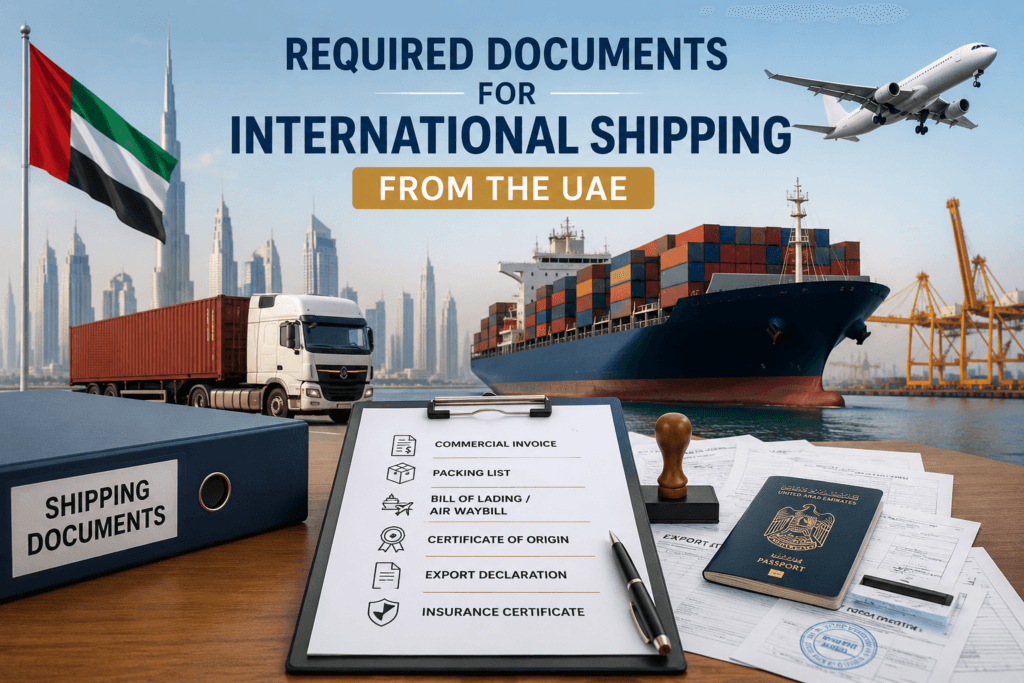
Understanding the required documents for international shipping from the UAE is the first and most important step toward ensuring a smooth, fast, and hassle-free shipping experience. Whether you are an individual sending personal belongings overseas or a business exporting products to international markets, preparing the required documents for international shipping from the UAE correctly can save significant time, money, and unnecessary complications.
Although many shipments leave the UAE without delays, even a minor mistake in one of the required documents for international shipping from the UAE can lead to customs clearance delays, additional fees, shipment inspections, or even refusal of entry into the destination country.
Knowing the required documents for international shipping from the UAE before your shipment is dispatched helps you avoid documentation errors, speed up customs clearance, and ensure compliance with both UAE export regulations and the import requirements of the receiving country.
The required documents for international shipping from the UAE may vary depending on several factors, including the type of goods being shipped, the chosen shipping method (air, sea, or land freight), the destination country, and whether the shipment is commercial or personal. Preparing the correct shipping documentation in advance not only minimizes delays but also reduces shipping costs and helps prevent unexpected customs issues.
In this comprehensive guide, you’ll discover every one of the required documents for international shipping from the UAE, understand the purpose of each document, learn when it is mandatory, and explore practical tips for preparing complete and accurate shipping paperwork. Whether you are a first-time shipper or an experienced exporter, this guide will help you organize your documentation efficiently and ensure a successful international shipping process.
If you are still deciding on the best transportation method, we also recommend reading our guide, “The Complete Guide to International Shipping Methods: Sea Freight vs. Air Freight vs. Land Freight,” where you’ll learn the advantages of each shipping option and choose the one that best fits your shipping needs.
Table of Contents
Why Are the Required Documents for International Shipping from the UAE Important?
The required documents for international shipping from the UAE form the foundation of every successful international shipment. Customs authorities, freight carriers, and logistics providers rely on these documents to verify shipment details, process exports and imports efficiently, and ensure compliance with international trade regulations.
Many people assume that international shipping simply involves packaging goods and handing them over to a shipping company. In reality, the required documents for international shipping from the UAE play a far more significant role. Customs authorities around the world use these official documents to verify the identities of the sender and recipient, confirm the nature and value of the goods, calculate customs duties and taxes, and ensure the shipment complies with local import and export regulations.
Accurate required documents for international shipping from the UAE also enable shipping companies and customs officials to monitor the shipment throughout its journey—from its departure from the UAE until it safely reaches its final destination.
Benefits of Preparing the Required Documents for International Shipping from the UAE
Properly preparing the required documents for international shipping from the UAE offers several important advantages for both individuals and businesses.
Avoid Shipping Delays
Errors in commercial invoices, incorrect shipment details, or missing shipping paperwork can trigger customs inspections and additional document reviews. As a result, shipments may be delayed for several days or even weeks before being cleared for delivery.
Reduce Additional Costs
Incomplete or inaccurate required documents for international shipping from the UAE can lead to warehouse storage charges, customs penalties, or demurrage fees while the shipment remains at the port or airport. Preparing every document correctly from the beginning helps avoid unnecessary expenses and keeps your shipping costs under control.
Ensure Compliance with International Trade Regulations
Most countries have specific documentation requirements for importing various categories of goods. Providing the correct required documents for international shipping from the UAE ensures compliance with these regulations and significantly reduces the risk of shipment rejection or customs complications.
For the latest customs regulations and import/export procedures in the UAE, refer to the official website of the UAE Federal Authority for Identity, Citizenship, Customs & Port Security (ICP).
Protect the Rights of All Parties
The required documents for international shipping from the UAE serve as official legal records that document every aspect of a shipment. They help protect the interests of exporters, importers, freight forwarders, and logistics companies by providing clear evidence of shipment details and supporting the resolution of disputes if they arise.
To better understand how these documents are used during customs processing, be sure to read our comprehensive guide on Customs Clearance in the UAE: A Complete Guide to Procedures, Requirements, and Fees.
Essential Required Documents for International Shipping from the UAE
Although documentation requirements may vary from one destination country to another, there are several required documents for international shipping from the UAE that are essential for most international shipments, whether transported by sea freight, air freight, or land freight.
The most common shipping documents include:
- Commercial Invoice
- Bill of Lading (B/L) or Air Waybill (AWB)
- Packing List
- Certificate of Origin
- Export License (when required)
- Customs Documentation
- Cargo Insurance Certificate
- Certificates of Conformity or Health Certificates (for regulated products)
- Passport or Emirates ID for individual shippers
- Trade License and Company Registration Documents for businesses
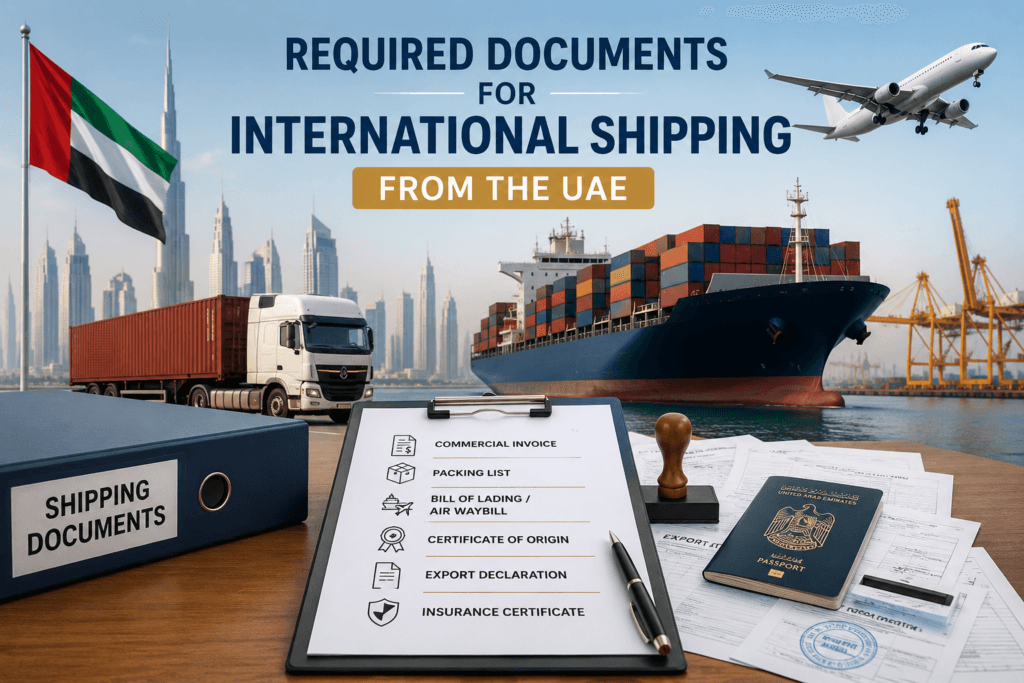
Each of these required documents for international shipping from the UAE plays a specific role in ensuring smooth customs clearance and successful international delivery. In the following sections, we’ll explain each document in detail, including its purpose, required information, and when it becomes mandatory.
Commercial Invoice
The Commercial Invoice is one of the most critical required documents for international shipping from the UAE. Customs authorities use this document to determine the customs value of the shipment, calculate applicable duties and taxes, and verify the commercial details of the goods being exported.
Because it serves as the primary financial document for international trade, every piece of information on the commercial invoice must be accurate and consistent with the rest of the shipping paperwork. Even minor discrepancies can result in customs delays or additional inspections.
If you’re looking for a reliable logistics partner to prepare your shipping documentation professionally, check out our guide on How to Choose the Best Shipping Company in the UAE: 10 Essential Factors to Consider.
What Should a Commercial Invoice Include?
A properly prepared commercial invoice should contain:
- Full name and address of the exporter (sender)
- Full name and address of the importer (recipient)
- Commercial invoice number
- Invoice issue date
- Detailed description of the goods
- Quantity of each item
- Net and gross weight
- Unit price of each product
- Total shipment value
- Currency used for the transaction
- Country of origin
- Incoterms® or agreed shipping terms
To avoid customs complications, all information on the commercial invoice should exactly match the other required documents for international shipping from the UAE, including the packing list and bill of lading.
For most commercial exports, the commercial invoice is considered one of the most important required documents for international shipping from the UAE.
Bill of Lading (B/L) / Air Waybill (AWB)
The Bill of Lading (B/L) and Air Waybill (AWB) are among the most essential required documents for international shipping from the UAE. These documents serve as official proof that the shipping company has received the cargo and agreed to transport it to the specified destination.
Besides acting as a transportation contract between the shipper and the carrier, the Bill of Lading or Air Waybill also enables shipment tracking and is required throughout almost every stage of the international shipping process.
Types of Shipping Documents
The type of shipping document depends on the transportation method selected.
Sea Bill of Lading
A Sea Bill of Lading is used for ocean freight shipments and often serves as a document of title, allowing ownership of the cargo to be transferred when required. It is commonly used for containerized cargo and large commercial shipments.
Air Waybill (AWB)
An Air Waybill is issued for air freight shipments. Since air cargo moves quickly, AWBs are typically generated electronically, allowing airlines, customs authorities, and freight forwarders to process shipments efficiently.
Land Freight Consignment Note
For road transportation between neighboring countries, carriers issue a land freight transport document containing shipment details, including:
- Sender information
- Recipient information
- Number of packages
- Gross weight
- Transportation method
- Destination border crossing, terminal, or warehouse
Choosing the correct Bill of Lading or Air Waybill is an essential part of preparing the required documents for international shipping from the UAE, as the document must match the selected shipping method.
To better understand the differences between sea, air, and land freight, read our guide The Complete Guide to International Shipping Methods: Sea Freight vs. Air Freight vs. Land Freight.
Packing List
A Packing List is another essential item among the required documents for international shipping from the UAE. Unlike the commercial invoice, this document focuses on the physical contents of the shipment rather than its financial value.
Many first-time exporters confuse the packing list with the commercial invoice, but each serves a completely different purpose. Customs officers and shipping companies rely on the packing list to inspect cargo quickly and verify that every package matches the accompanying documentation.
A Packing List Typically Includes
- Total number of cartons or packages
- Dimensions of each package
- Net weight
- Gross weight
- Packaging type
- Detailed contents of every carton
- Package numbers for multi-package shipments
Preparing a detailed and accurate packing list significantly speeds up customs inspections, minimizes examination time, and helps customs authorities release shipments more efficiently.
Because of its role in customs verification, the packing list remains one of the core required documents for international shipping from the UAE for nearly every international shipment.
Certificate of Origin (COO)
The Certificate of Origin (COO) is one of the most important required documents for international shipping from the UAE, particularly for commercial exports. This certificate confirms the country where the goods were manufactured or substantially produced and enables customs authorities to determine applicable tariffs and preferential duty rates under international trade agreements.
In many cases, presenting a valid Certificate of Origin allows importers to benefit from reduced customs duties or exemptions under free trade agreements between the UAE and the destination country.
When Is a Certificate of Origin Required?
Although documentation requirements vary by country, a Certificate of Origin is commonly required when:
- Exporting commercial goods
- Shipping to countries that require proof of manufacturing origin
- Claiming benefits under free trade agreements
- Exporting industrial, food, pharmaceutical, or regulated products
For many low-value personal shipments, a Certificate of Origin may not be necessary. The requirement ultimately depends on the shipment type and the import regulations of the destination country.
Information Included in a Certificate of Origin
A Certificate of Origin generally contains:
- Exporter’s name
- Importer’s name
- Description of the goods
- Country of origin
- Number of packages
- Shipment weight
- Shipment value (where applicable)
- Chamber of Commerce certification or issuing authority details
If you’d like to understand the complete export process from the UAE to international destinations, be sure to read our guide Shipping from the UAE to GCC Countries: Shipping Costs, Transit Times, and Customs Procedures.
Customs Documents
Among the most important required documents for international shipping from the UAE are the customs documents that enable customs authorities to verify shipment information and ensure compliance with both UAE export regulations and the import requirements of the destination country.
Accurate and complete customs documentation helps speed up customs clearance, minimizes inspection delays, and reduces the risk of additional charges or shipment rejection.
Essential Customs Documents
Although customs requirements vary from one country to another, the following documents are commonly required for international shipments:
- Commercial Invoice
- Packing List
- Bill of Lading (B/L) or Air Waybill (AWB)
- Certificate of Origin
- Export Declaration
- Special permits for regulated goods
- Certificates of Conformity or compliance certificates (when applicable)
These required documents for international shipping from the UAE work together to provide customs authorities with complete information about the shipment and ensure a smooth clearance process.
Why Customs Authorities Require These Documents
Customs officials review shipping documents to:
- Calculate customs duties and taxes
- Verify the declared shipment value
- Confirm that prohibited or restricted goods are not included
- Determine the country of origin
- Ensure compliance with product-specific import regulations
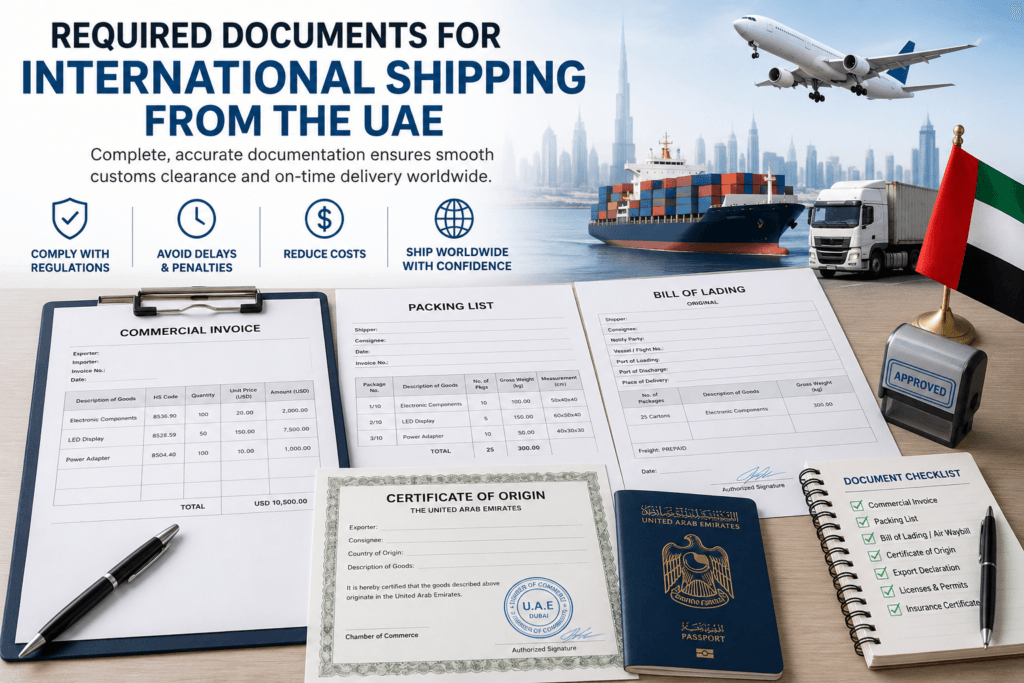
Any inconsistency between the required documents for international shipping from the UAE may trigger additional inspections, document requests, or customs delays. For this reason, exporters should carefully review every document before submitting their shipment.
For a detailed explanation of the customs clearance process, read our guide Customs Clearance in the UAE: A Complete Guide to Procedures and Fees.
You can also stay up to date with the latest customs regulations by visiting the official website of the UAE Federal Authority for Identity, Citizenship, Customs & Port Security (ICP).
Customs Documentation Checklist
| Document | Purpose | Usually Required |
|---|---|---|
| Commercial Invoice | Determines the customs value of the shipment | ✅ Yes |
| Bill of Lading / Air Waybill | Transportation contract and shipment receipt | ✅ Yes |
| Packing List | Details the shipment contents | ✅ Usually Required |
| Certificate of Origin | Confirms the manufacturing country | ✅ Required by many countries |
| Cargo Insurance Certificate | Protects high-value shipments | Optional |
If you are planning to ship goods to GCC countries, we recommend reading our article Shipping from the UAE to GCC Countries: Shipping Costs, Delivery Times, and Customs Procedures to understand the documentation requirements for each destination.
Certificates of Conformity and Special Permits
Not every shipment requires additional certifications. However, certain categories of goods cannot be exported or imported without obtaining specialized certificates or government approvals.
These documents ensure that products comply with the technical, health, environmental, and safety standards enforced by the importing country.
Products That May Require Additional Certificates
Some products commonly requiring additional documentation include:
- Electrical equipment
- Medical devices
- Food and beverages
- Cosmetics
- Chemical products
- Children’s toys
- Industrial machinery and equipment
Depending on the destination country, importers may need to provide Certificates of Conformity (CoC), health certificates, import permits, or other regulatory approvals before customs authorities release the shipment.
Why These Certificates Matter
Preparing the correct required documents for international shipping from the UAE, including product-specific certificates, helps to:
- Prevent shipment rejection
- Accelerate customs clearance
- Meet international regulatory requirements
- Protect consumers
- Reduce the risk of shipments being returned to the country of origin
Cargo Insurance Certificate
Although cargo insurance is not mandatory for every shipment, it is strongly recommended for businesses and individuals shipping valuable goods internationally.
A Cargo Insurance Certificate provides financial protection against risks that may occur during transportation, including accidental damage, theft, loss, or unforeseen events while goods are in transit.
For high-value cargo or long-distance shipments, cargo insurance is considered one of the most valuable required documents for international shipping from the UAE, offering peace of mind throughout the shipping journey.
When Should You Purchase Cargo Insurance?
Cargo insurance is highly recommended for:
- Electronic devices
- Industrial equipment
- High-value merchandise
- Long-distance sea freight shipments
- Large commercial exports
What Does Cargo Insurance Cover?
Coverage varies depending on the insurance provider and policy, but it commonly includes:
- Physical damage during transportation
- Partial or total cargo loss
- Theft
- Transportation accidents
- Certain natural disasters, subject to policy terms
Additional Documents by Product Type
Different products often require additional documentation beyond the standard required documents for international shipping from the UAE.
| Product Category | Possible Additional Documents | Purpose |
|---|---|---|
| Food Products | Health Certificate | Verifies food safety standards |
| Electrical Equipment | Certificate of Conformity | Confirms compliance with technical regulations |
| Medical Products | Import Permit & Quality Certificates | Meets healthcare regulations |
| Chemical Products | Safety Data Sheet (SDS) | Ensures safe handling and transportation |
| Industrial Equipment | Technical Certificates | Demonstrates compliance with industrial standards |
Important Note: The required documents for international shipping from the UAE always depend on the nature of the goods, the shipping method, and the regulations of the destination country. Before preparing your shipment, consult your freight forwarder or customs broker to ensure all required documents are complete and up to date.
Required Documents for Individuals Shipping Internationally from the UAE
The required documents for international shipping from the UAE differ slightly for individuals and businesses. Personal shipments generally involve fewer formalities, especially when sending personal belongings, gifts, or household items abroad. However, preparing the correct documentation is still essential to ensure your shipment reaches its destination without delays.
The exact documents required depend on several factors, including the shipment’s value, its contents, the destination country, and the shipping company’s policies.
Essential Documents for Individual Shippers
In most cases, individuals should prepare the following required documents for international shipping from the UAE:
- Copy of a valid passport or Emirates ID
- Complete sender and recipient information
- Commercial Invoice or a declared value statement (when required)
- Packing List
- Bill of Lading or Air Waybill issued by the carrier
- Additional permits if the shipment contains regulated or restricted goods
Accurate recipient information—including the full name, delivery address, and phone number—is extremely important. Even minor errors can delay customs clearance or final delivery.
When Is Proof of Shipment Value Required?
Some customs authorities require supporting documents showing the actual value of shipped goods, even for personal shipments. This helps customs officials calculate duties accurately and prevents under-declaration of shipment values.
Required Documents for Businesses Shipping Internationally from the UAE
Commercial exports usually require a broader range of documentation than personal shipments. Businesses must comply with international trade regulations, customs procedures, and product-specific import requirements.
For companies that export regularly, maintaining complete and organized required documents for international shipping from the UAE is a critical part of efficient logistics management.
Essential Business Shipping Documents
Most commercial shipments require:
- Trade License
- Commercial Registration (when applicable)
- Commercial Invoice
- Packing List
- Bill of Lading or Air Waybill
- Certificate of Origin
- Export Declaration
- Certificates of Conformity or Health Certificates (when required)
- Cargo Insurance Certificate (if insured)
Having these required documents for international shipping from the UAE prepared in advance significantly reduces customs delays and helps ensure uninterrupted international trade operations.
Why Organized Documentation Matters
Maintaining digital and physical copies of all export documents allows businesses to streamline future shipments, simplify customs procedures, and minimize the risk of losing important paperwork.
If you’re searching for a trusted logistics partner, explore our guide How to Choose the Best Shipping Company in the UAE: 10 Essential Factors to Consider.
Do the Required Documents Vary by Shipping Method?
Yes. While several required documents for international shipping from the UAE are mandatory regardless of the transportation method, certain documents are specific to air, sea, or land freight.
Air Freight Documents
Air freight is known for its speed and efficiency, making accurate documentation especially important.
Typical air freight documentation includes:
- Air Waybill (AWB)
- Commercial Invoice
- Packing List
- Certificate of Origin (when required)
- Dangerous Goods Declaration (if applicable)
Preparing these required documents for international shipping from the UAE correctly helps airlines and customs authorities process shipments quickly while minimizing delays.
Sea Freight Documents
Sea freight is commonly used for large commercial shipments and full-container exports.
Standard sea freight documentation includes:
- Ocean Bill of Lading
- Commercial Invoice
- Packing List
- Certificate of Origin
- Cargo Insurance Certificate (recommended)
- Product-specific permits and certificates when applicable
Since ocean freight often involves multiple customs inspections, ensuring that all required documents for international shipping from the UAE are complete is essential for smooth cargo movement.
Land Freight Documents
Road freight is widely used between the UAE and neighboring GCC countries.
Common land freight documentation includes:
- Road Consignment Note
- Commercial Invoice
- Packing List
- Certificate of Origin (if required)
- Product-specific permits
Although documentation for land freight may appear simpler, exporters must still ensure all required documents for international shipping from the UAE comply with the destination country’s import regulations.
Common Mistakes When Preparing International Shipping Documents
Even when exporters gather all the required documents for international shipping from the UAE, small documentation errors can cause customs delays, additional fees, or shipment rejection.
Carefully reviewing every document before submitting your shipment is one of the best ways to avoid costly mistakes.
Most Common Documentation Errors
Some of the most frequent issues include:
- Different recipient names across documents
- Incomplete or incorrect delivery addresses
- Declared shipment values that do not match the actual goods
- Missing signatures or official stamps where required
- Vague product descriptions
- Outdated company information
- Expired licenses or certificates
- Failing to include a Certificate of Origin when required
How to Avoid Documentation Errors
Following these best practices will help ensure your required documents for international shipping from the UAE are accurate and complete:
- Review every document carefully before shipment.
- Keep secure digital copies of all shipping paperwork.
- Work with an experienced freight forwarding company.
- Verify the documentation requirements of the destination country before shipping.
- Update your company’s licenses and official documents regularly.
Pro Tip: If you frequently ship to the same destination, create a standardized documentation checklist. Using the same verified checklist for every shipment reduces errors, speeds up document preparation, and simplifies future international shipping operations.
Professional Tips for Preparing the Required Documents for International Shipping from the UAE
Preparing the required documents for international shipping from the UAE correctly from the very beginning can significantly reduce shipping delays, prevent unnecessary customs charges, and ensure a smooth customs clearance process. Well-organized documentation also enables freight forwarders and customs authorities to process shipments more efficiently.
To ensure your shipment is ready for international transport, follow these best practices.
Double-Check Every Detail
Before submitting your shipment, carefully review all the required documents for international shipping from the UAE. Make sure the sender’s and recipient’s names, addresses, phone numbers, shipment values, and product descriptions are consistent across every document. Even minor discrepancies can delay customs clearance.
Provide Accurate Product Descriptions
Avoid using vague descriptions such as “General Goods” or “Miscellaneous Items.” Instead, provide clear and detailed information about each product, including its quantity, material, intended use, and declared value. Accurate descriptions help customs authorities classify goods correctly and speed up inspections.
Keep Digital and Printed Copies
Store electronic copies of all required documents for international shipping from the UAE in PDF format, while also keeping printed originals whenever necessary. Having backup copies allows you to quickly respond to requests from customs officials or shipping companies.
Verify the Destination Country’s Requirements
Every country has its own import regulations and documentation requirements. Before shipping, confirm which required documents for international shipping from the UAE are needed for your destination, particularly when exporting food products, pharmaceuticals, chemicals, medical devices, or industrial equipment.
Work with an Experienced Shipping Company
Partnering with an experienced freight forwarding company can help you prepare the required documents for international shipping from the UAE accurately and avoid costly mistakes. Many logistics providers also offer document verification services before your shipment is dispatched.
Step-by-Step Checklist Before Shipping
Use the following checklist to make sure your shipment is fully prepared before handing it over to your shipping provider.
Step 1
Determine whether your shipment is personal or commercial.
Step 2
Identify the mandatory required documents for international shipping from the UAE based on the type of goods being exported.
Step 3
Prepare the Commercial Invoice and Packing List, then carefully verify every detail.
Step 4
Obtain the Certificate of Origin and any additional certificates or permits required for your products.
Step 5
Submit all shipping documents to your freight forwarder for review before the Bill of Lading or Air Waybill is issued.
Step 6
Keep copies of every shipping document until the recipient successfully receives the shipment.
International Shipping Documents Checklist
Before shipping internationally from the UAE, make sure you have prepared the following:
✅ Commercial Invoice
✅ Bill of Lading or Air Waybill
✅ Packing List
✅ Certificate of Origin (if required)
✅ Export Declaration
✅ Cargo Insurance Certificate (if applicable)
✅ Certificates of Conformity or Health Certificates (if required)
✅ Trade License (for businesses)
✅ Passport or Emirates ID (for individuals)
Preparing the required documents for international shipping from the UAE correctly helps reduce delays, lower shipping costs, and ensure that both personal and commercial shipments arrive safely and on time.
Additional Documents That May Be Required
| Document | Required for Most Shipments | When It Is Needed |
|---|---|---|
| Commercial Invoice | ✔ | Required for customs clearance |
| Packing List | ✔ | Required for cargo inspection |
| Certificate of Origin | Sometimes | Required by some destination countries |
| Air Waybill / Bill of Lading | ✔ | Depends on the shipping method |
| Export Declaration | ✔ | Required before export from the UAE |
What Documents Are Required for Exporting Electronic Goods from the UAE?
Exporting electronic goods from the UAE generally requires the same core shipping documents used for most international shipments. However, depending on the destination country and the type of electronic products, additional certifications or approvals may also be necessary.
The standard documents usually include:
- Commercial Invoice – Lists the products, quantities, values, and buyer and seller information.
- Packing List – Details the contents, dimensions, and weight of each package.
- Air Waybill (AWB) or Bill of Lading (B/L) – The transport document issued by the carrier based on the shipping method.
- Certificate of Origin – May be required by the destination country’s customs authorities.
- Export Declaration – Required for customs clearance before the shipment leaves the UAE.
- Special Permits (if applicable) – Certain electronic products, such as devices with wireless communication features or controlled technologies, may require additional approvals depending on UAE regulations and the destination country’s import rules.
Before shipping electronic products internationally, it is always recommended to verify the documentation requirements with your freight forwarder and the customs authorities of the destination country to avoid delays or customs clearance issues.
Tip: Shipping electronic goods often involves stricter customs inspections than general cargo. Ensuring that all shipping documents are complete and accurate can significantly reduce customs delays.
Frequently Asked Questions (FAQs)
What are the most important required documents for international shipping from the UAE?
The essential required documents for international shipping from the UAE typically include a Commercial Invoice, Bill of Lading or Air Waybill, and Packing List. Depending on the shipment and destination country, you may also need a Certificate of Origin, Export Declaration, insurance documents, or product-specific certificates.
Are the required documents different for individuals and businesses?
Yes. Businesses generally need additional documentation such as a Trade License, Export Declaration, and Certificate of Origin, while individual shippers usually have simpler documentation requirements.
Is a Certificate of Origin mandatory?
Not always. Whether a Certificate of Origin is required depends on the destination country’s regulations, the type of goods being shipped, and any applicable trade agreements.
Can I ship goods without a Commercial Invoice?
For most commercial shipments, no. A Commercial Invoice is one of the primary required documents for international shipping from the UAE because customs authorities use it to assess the shipment’s value and calculate import duties and taxes.
What is the difference between a Commercial Invoice and a Packing List?
A Commercial Invoice provides the financial value of the shipment, while a Packing List describes the physical contents, packaging details, dimensions, and weights of each package.
Can shipping documents be corrected after the shipment has been dispatched?
Some documents may be amended depending on the shipping stage and carrier policies. However, correcting documentation before issuing the Bill of Lading or Air Waybill is always recommended to avoid customs delays.
Is cargo insurance mandatory?
Cargo insurance is generally optional. However, it is highly recommended for valuable goods, commercial shipments, and long-distance international transportation to protect against financial loss.
How can I avoid customs clearance delays?
Preparing complete and accurate required documents for international shipping from the UAE, verifying every detail, complying with the destination country’s import regulations, and working with an experienced logistics provider are the most effective ways to minimize customs delays.
Conclusion
Preparing the required documents for international shipping from the UAE is one of the most important steps in ensuring a smooth, secure, and efficient international shipping process. Whether you are sending personal belongings or managing commercial exports, accurate documentation plays a vital role in customs clearance, regulatory compliance, and timely delivery.
Reviewing every document before shipping and ensuring it meets the destination country’s import requirements can help you avoid unnecessary delays, unexpected costs, and customs complications. By preparing the required documents for international shipping from the UAE correctly, individuals and businesses can enjoy faster shipping, reduced risks, and a more reliable international logistics experience.
Contact Us
Looking for a trusted international shipping company in the UAE?
Our experienced logistics team is ready to assist you with preparing the required documents for international shipping from the UAE, customs clearance services, freight forwarding, and selecting the most suitable shipping solution for your business or personal shipment.