

Introduction
Volumetric Weight in International Shipping is one of the most important factors affecting international shipping costs, yet many individuals and businesses are surprised when they receive a shipping quote that is significantly higher than expected. Even if a shipment appears lightweight, the final freight cost may be calculated based on its volumetric weight rather than its actual weight, especially for air freight shipments.
Shipping carriers calculate freight charges by comparing the actual weight of a package with its volumetric (dimensional) weight. Large but lightweight packages occupy valuable cargo space inside an aircraft, shipping container, or delivery vehicle, making them more expensive to transport than smaller, heavier parcels. For this reason, the higher value between the actual weight and the volumetric weight becomes the chargeable weight used for billing.
Understanding Volumetric Weight in International Shipping is essential for accurately estimating shipping costs, choosing the most cost-effective packaging, and avoiding unexpected freight charges. Whether you are shipping personal belongings, commercial goods, or e-commerce orders, knowing how dimensional weight works can help you optimize your logistics strategy.
In this comprehensive guide, you’ll learn what Volumetric Weight in International Shipping is, how to calculate it, the differences between volumetric and actual weight, the factors that influence dimensional weight, and practical examples to help you reduce international shipping costs while improving shipping efficiency.

Table of Contents
What Is Volumetric Weight in International Shipping?
Volumetric Weight in International Shipping, also known as Dimensional Weight (DIM Weight), refers to the amount of space a shipment occupies during transportation rather than its actual physical weight.
Shipping companies use this calculation to maximize the available cargo space in aircraft, trucks, and shipping containers. A large but lightweight package can occupy the same amount of cargo space as a much heavier shipment, preventing additional freight from being loaded. As a result, transportation costs are based not only on weight but also on the space a shipment consumes.
To determine the chargeable weight, carriers compare the actual weight with the volumetric weight and charge based on whichever value is higher.
Most international air freight companies follow globally recognized standards when calculating volumetric weight. You can learn more about these industry guidelines through the International Air Transport Association (IATA).
Why Do Shipping Companies Use Volumetric Weight?
There are several reasons why Volumetric Weight in International Shipping plays a crucial role in freight pricing.
Maximizing Cargo Space
Cargo space inside aircraft, trucks, and shipping containers is limited. Charging based on the occupied volume helps carriers make the most efficient use of available capacity.
Fair Pricing for Customers
A customer shipping a large box should not pay the same shipping rate as someone shipping a compact package with the same actual weight. Volumetric pricing creates a fairer pricing structure.
Improving Shipping Efficiency
Calculating dimensional weight enables logistics providers to optimize cargo loading, improve transportation efficiency, and maximize the carrying capacity of every shipment.
You can also read our guide on How to Choose the Best Shipping Company in the UAE to learn how experienced logistics providers accurately calculate volumetric weight and help reduce unnecessary shipping costs.
Actual Weight vs. Volumetric Weight
| Actual Weight | Volumetric Weight |
|---|---|
| Based on the shipment’s physical weight (kg) | Based on the shipment’s dimensions |
| Measured using a scale | Calculated using a mathematical formula |
| Best for dense and heavy cargo | Best for large but lightweight shipments |
| May not always be the chargeable weight | Often becomes the chargeable weight if higher |
After comparing both values, the shipping company uses the higher figure as the chargeable weight for billing purposes.
How to Calculate Volumetric Weight in International Shipping
Understanding Volumetric Weight in International Shipping allows you to estimate shipping costs before sending your cargo and avoid unexpected freight charges.
The standard formula is:
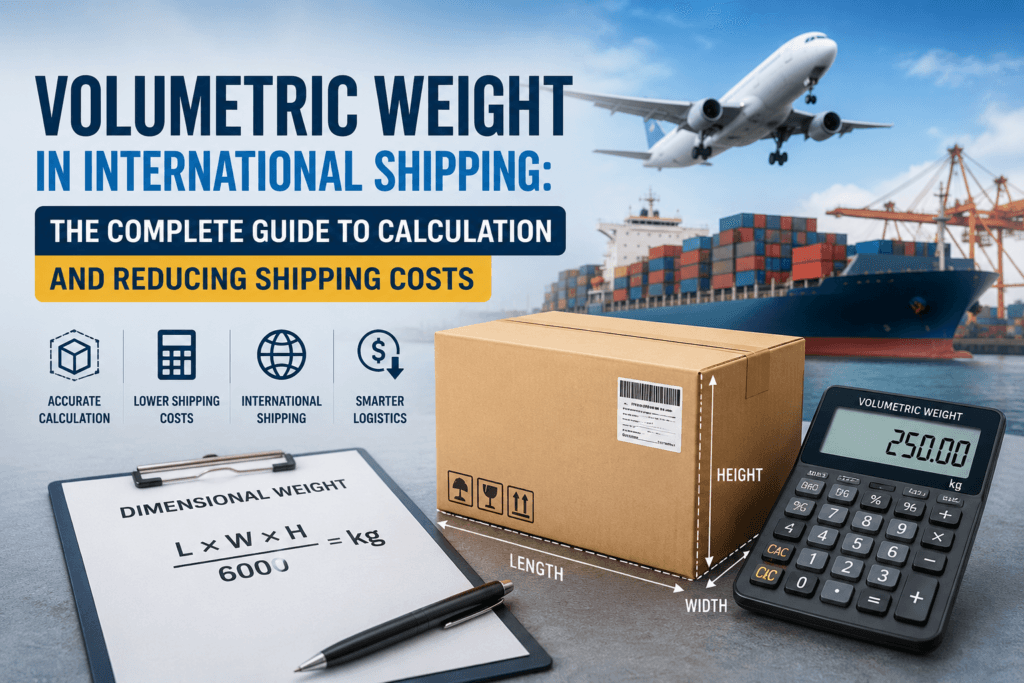
Volumetric Weight = Length × Width × Height ÷ Conversion Factor
All dimensions are measured in centimeters (cm).
Common Conversion Factors
| Shipping Method | Conversion Factor |
|---|---|
| Air Freight | 5000 |
| Express Courier Services | 5000–6000 |
| Other Logistics Providers | Depends on Company Policy |
Practical Example
Suppose your package measures:
- Length: 60 cm
- Width: 40 cm
- Height: 50 cm
Calculation:
60 × 40 × 50 = 120,000 cm³
120,000 ÷ 5,000 = 24 kg
If the actual weight is 18 kg, the shipping company will charge based on 24 kg, since the volumetric weight is higher.
If the actual weight is 30 kg, the shipment will instead be charged based on 30 kg, as it exceeds the dimensional weight.
When Is Volumetric Weight Higher Than Actual Weight?
In most cases, Volumetric Weight in International Shipping exceeds the actual weight when shipping items that are lightweight but occupy a significant amount of space. Common examples include:
- Pillows and cushions
- Clothing and textiles
- Toys
- Plastic products
- Flat-pack furniture
- Promotional materials
- Empty containers and packaging
- Foam products
Although these products weigh very little, they consume valuable cargo space, making their volumetric weight higher than their physical weight.
When Is Actual Weight Used Instead?
Shipping companies charge based on the actual weight when transporting dense or heavy products whose physical weight exceeds their dimensional weight. Examples include:
- Metal products
- Automotive spare parts
- Industrial machinery
- Stone and construction materials
- Heavy equipment
In these cases, the actual weight becomes the chargeable weight because it is greater than the volumetric weight.
How Does Volumetric Weight Affect International Shipping Costs?
Volumetric Weight in International Shipping has a direct impact on freight charges. The larger the package dimensions, the higher the dimensional weight—and consequently, the higher the shipping cost.
Even if the actual weight remains unchanged, reducing the package size can significantly lower shipping expenses.
For this reason, logistics providers recommend using packaging that closely matches the size of the product and minimizing empty space inside the box whenever possible.
Tips to Reduce Volumetric Weight and Lower Shipping Costs
Choose the Right Box Size
Using packaging that closely fits your product minimizes unused space and reduces volumetric weight.
Use Professional Packaging
Proper packing techniques protect your shipment while keeping its dimensions as compact as possible.
Eliminate Empty Space
Use cushioning materials efficiently to prevent unnecessary increases in package volume.
Compress Foldable Products
Items such as clothing, fabrics, pillows, and soft goods can often be compressed to reduce package dimensions.
Work with an Experienced Shipping Company
Professional logistics providers can recommend the most cost-effective packaging solutions and help reduce unnecessary shipping expenses.
Measure Your Shipment Before Shipping
Accurately measuring the length, width, height, and weight of your package allows you to estimate shipping costs in advance and avoid unexpected charges.
Reducing Volumetric Weight in International Shipping with Professional Packaging
Does Volumetric Weight Differ Between Air, Sea, and Road Freight?
Yes. The method used to calculate Volumetric Weight in International Shipping varies depending on the transportation mode and the shipping company’s pricing policy.
Air freight relies most heavily on volumetric weight because cargo space inside aircraft is limited and highly valuable. Sea freight and road freight may use different conversion factors or pricing formulas depending on the type of cargo, container size, and carrier requirements.
Before shipping internationally, it is always advisable to confirm the dimensional weight calculation method used by your chosen logistics provider.
Proper documentation is just as important as calculating volumetric weight. Read our guide on Required Documents for International Shipping from the UAE to ensure your shipment complies with all documentation requirements.
If you are shipping from the UAE, you should also review the latest customs regulations issued by the Federal Authority for Identity, Citizenship, Customs & Port Security (ICP) to ensure smooth customs clearance.
Frequently Asked Questions
Is shipping cost always calculated based on actual weight?
No. Shipping companies compare the actual weight with the volumetric weight and charge based on whichever is higher.
Do all shipping companies use the same volumetric weight formula?
The basic formula is generally the same, but the conversion factor may vary depending on the carrier and shipping service.
Does package size affect shipping costs?
Yes. Larger package dimensions increase the volumetric weight, which can significantly raise international shipping costs.
How can I estimate shipping costs before sending my shipment?
Measure your shipment’s dimensions and actual weight, calculate the volumetric weight, and compare the two values. Alternatively, request a shipping quote from your logistics provider.
Contact Us for an Accurate Volumetric Weight Calculation
Would you like to know your shipping cost before sending your cargo?
Our international shipping specialists provide professional assistance in calculating Volumetric Weight in International Shipping, estimating freight costs, selecting the most suitable packaging, and choosing the best shipping solution for your needs.
Contact us today for a fast, no-obligation shipping quote. Whether you’re shipping documents, personal belongings, or commercial goods from the UAE to destinations worldwide, we’ll help you reduce costs while ensuring safe, reliable, and timely delivery.
Conclusion
Understanding Volumetric Weight in International Shipping is essential for anyone involved in international trade, e-commerce, or personal shipping. Knowing how dimensional weight is calculated allows you to estimate shipping costs more accurately, avoid unexpected charges, and make informed logistics decisions.
By choosing appropriately sized packaging, minimizing unused space, and working with an experienced shipping provider, you can significantly reduce volumetric weight without compromising the safety of your shipment.
If you’re looking for reliable international shipping services from the UAE, our team is ready to help you calculate volumetric weight accurately, optimize your shipping strategy, and provide comprehensive logistics solutions tailored to both businesses and individuals.