

introduction
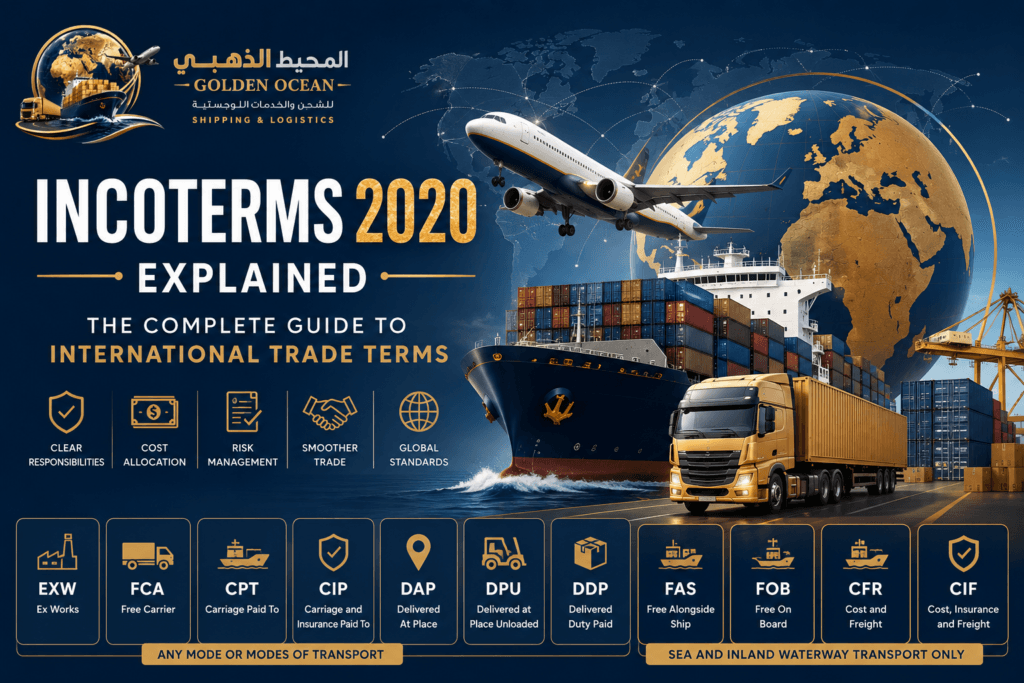
Incoterms 2020 are the globally recognized international trade rules that define the responsibilities of buyers and sellers during the transportation of goods across borders. Whether you are importing, exporting, or managing international logistics, understanding Incoterms® 2020 is essential for avoiding costly misunderstandings, reducing shipping risks, and ensuring smooth global trade operations.
Published by the International Chamber of Commerce (ICC), the latest version of Incoterms provides a standardized framework that clearly determines who is responsible for transportation costs, customs clearance, insurance obligations, cargo handling, and the transfer of risk throughout the shipping process.
In this comprehensive guide, you’ll learn what each Incoterms® 2020 rule means, the differences between all 11 Incoterms, how to choose the right rule for your shipments, and common mistakes businesses should avoid when trading internationally.
In This Guide You’ll Learn
What Incoterms® 2020 are and why they matter
The differences between the 11 Incoterms rules
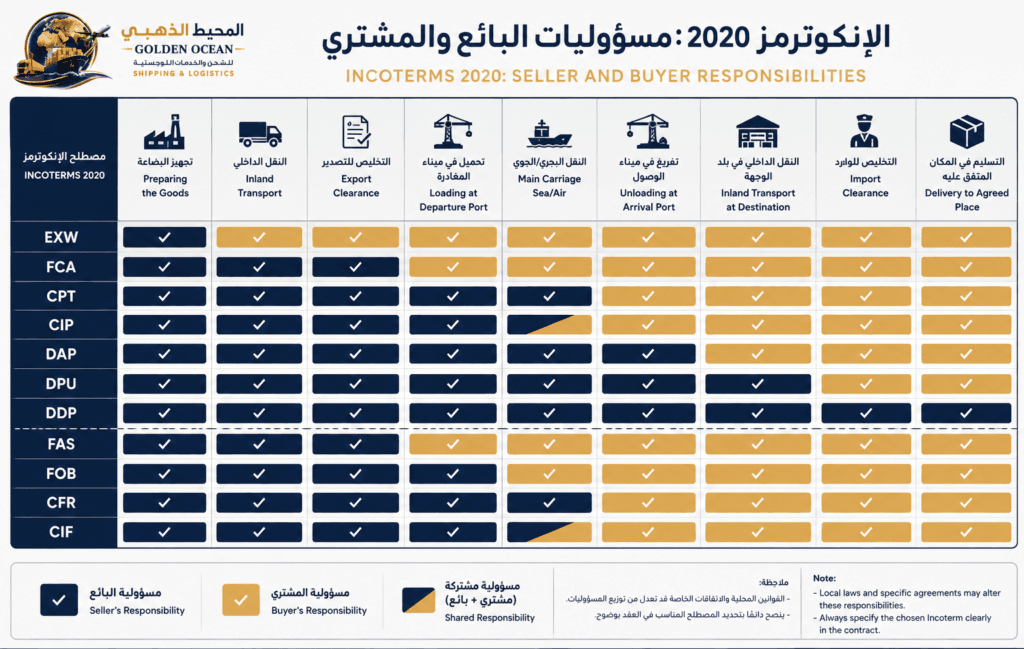
Buyer and seller responsibilities under each Incoterm
Which Incoterms apply to sea freight and which work for all transport modes
The transfer of costs and risks in every shipping rule
How to choose the right Incoterm for your business
Common mistakes businesses make when using Incoterms
Frequently asked questions about Incoterms® 2020
Table Of Content
What Are Incoterms® 2020?
Incoterms® 2020 (International Commercial Terms) are a set of internationally accepted trade rules published by the International Chamber of Commerce (ICC). They define the responsibilities of buyers and sellers involved in international transactions, ensuring both parties clearly understand who is responsible for transportation, export and import customs clearance, insurance, delivery, shipping costs, and the transfer of risk.
Rather than replacing a sales contract, Incoterms complement commercial agreements by providing standardized shipping terms that reduce misunderstandings and disputes between trading partners worldwide.
Each Incoterm specifies the exact point where responsibility and risk move from the seller to the buyer. This clarity helps businesses estimate shipping costs more accurately, manage logistics efficiently, and comply with international trade requirements.
Today, Incoterms® 2020 are widely used by exporters, importers, freight forwarders, customs brokers, shipping companies, manufacturers, wholesalers, retailers, and e-commerce businesses operating in global markets.
Understanding these rules is essential for anyone involved in international shipping, as selecting the wrong Incoterm can lead to unexpected transportation expenses, customs delays, insurance gaps, or legal disputes.
Why Are Incoterms® 2020 Important in International Trade?
International trade involves multiple parties, transportation methods, customs authorities, and legal requirements. Without clearly defined responsibilities, misunderstandings over shipping costs, delivery obligations, insurance, or customs procedures can quickly become expensive disputes.
This is where Incoterms 2020 play a vital role. They provide a universal language that buyers and sellers around the world understand, making international transactions more transparent and predictable.
Some of the key benefits of using Incoterms® 2020 include:
- Clearly defining the responsibilities of buyers and sellers
- Reducing misunderstandings during international transactions
- Determining exactly when the risk transfers from the seller to the buyer
- Clarifying who pays for transportation, customs clearance, insurance, and terminal charges
- Supporting smoother customs procedures and international documentation
- Helping businesses estimate total shipping costs more accurately
- Improving communication between exporters, importers, freight forwarders, and logistics providers
- Minimizing legal disputes arising from unclear shipping agreements
Whether shipping by air, sea, road, or rail, selecting the appropriate Incoterm helps businesses protect their interests while creating a more efficient international supply chain.
The Main Responsibilities Covered by Incoterms®
Each Incoterm defines several critical responsibilities throughout the shipping process, including:
| Responsibility | Seller | Buyer |
|---|---|---|
| Export customs clearance | Depends on Incoterm | Depends on Incoterm |
| Loading goods | Depends on Incoterm | Depends on Incoterm |
| Main international transportation | Depends on Incoterm | Depends on Incoterm |
| Cargo insurance | Depends on Incoterm | Depends on Incoterm |
| Import customs clearance | Usually Buyer | Usually Buyer |
| Import duties and taxes | Usually Buyer | Usually Buyer |
| Delivery location | Defined by the selected Incoterm | Defined by the selected Incoterm |
| Transfer of risk | Specified in every Incoterm | Specified in every Incoterm |
Because these responsibilities vary depending on the selected rule, businesses should never assume that all Incoterms provide the same level of seller responsibility.
What’s New in Incoterms® 2020?
The Incoterms® 2020 rules replaced the previous Incoterms® 2010 edition and introduced several updates designed to better reflect modern international trade practices.
The most significant changes include:
1. DAT Was Replaced by DPU
One of the biggest updates was replacing Delivered at Terminal (DAT) with Delivered at Place Unloaded (DPU).
The new DPU rule offers greater flexibility because delivery can now occur at virtually any agreed destination where unloading is possible, rather than being limited to a transportation terminal.
2. Different Insurance Levels Under CIP and CIF
Insurance requirements were updated to better reflect commercial practice.
- CIP (Carriage and Insurance Paid To) now requires higher insurance coverage, generally equivalent to Institute Cargo Clauses (A).
- CIF (Cost, Insurance and Freight) continues to require the lower minimum insurance level commonly associated with Institute Cargo Clauses (C).
This distinction recognizes that CIP is often used for manufactured goods with higher values, while CIF remains common for bulk commodities transported by sea.
3. Greater Flexibility for Own Means of Transport
Several Incoterms now recognize situations where buyers or sellers transport goods using their own vehicles instead of hiring third-party carriers.
This reflects the growing number of companies managing transportation internally within regional and international supply chains.
4. Improved Security Requirements
The updated rules place greater emphasis on transportation security throughout the logistics process.
Security-related obligations, including documentation and compliance requirements, are now integrated into the relevant responsibilities under each Incoterm.
5. Better Allocation of Transport Costs
Incoterms® 2020 provide clearer guidance on transportation costs by grouping cost obligations within each rule.
This reduces confusion over terminal handling charges, loading costs, unloading fees, and other logistics expenses that previously caused disputes.
A Brief History of Incoterms®
The International Chamber of Commerce (ICC) first introduced Incoterms in 1936 to create a standardized set of international trade rules.
Since then, the rules have been updated several times to reflect changes in global trade, transportation methods, and commercial practices.
Major revisions include:
| Edition | Key Development |
| 1936 | First publication of Incoterms |
| 1953 | Expanded rules following post-war international trade growth |
| 1967 | Additional clarifications for global commerce |
| 1976 | Updates for air freight transactions |
| 1980 | Adaptation to containerized shipping |
| 1990 | Simplified terminology and responsibilities |
| 2000 | Improved compatibility with electronic trade documentation |
| 2010 | Reduced the number of rules from 13 to 11 |
| 2020 | Latest version introducing DPU, revised insurance requirements, and improved cost allocation |
Today, Incoterms® 2020 remain the internationally accepted standard for allocating costs, risks, and responsibilities between buyers and sellers in global trade.
The 11 Incoterms® 2020 Rules
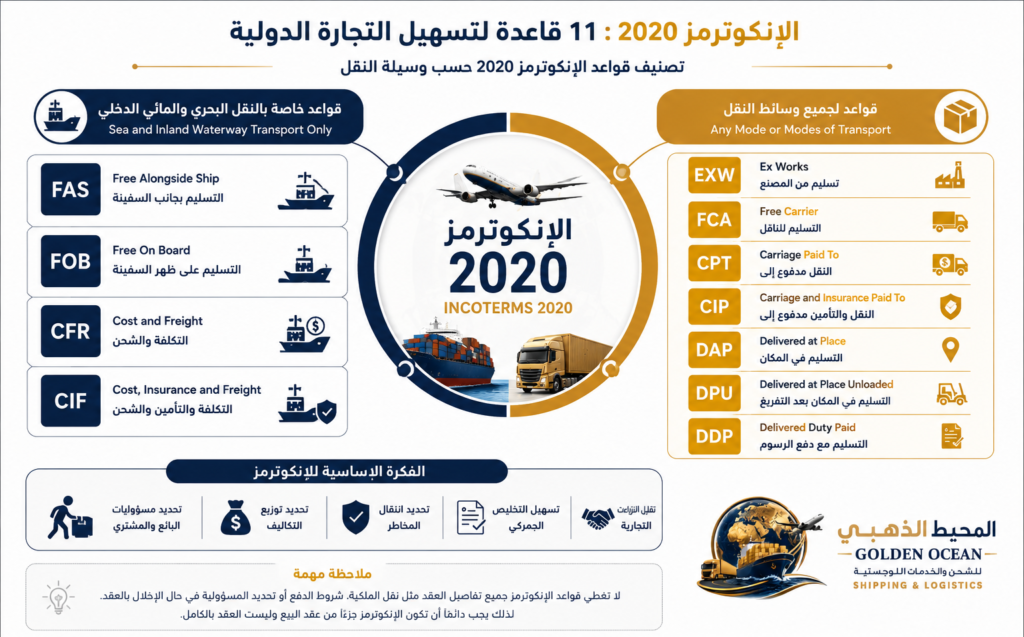
The 11 Incoterms® 2020 are divided into two categories:
Incoterms for Any Mode of Transport
These rules can be used for air freight, road transport, rail freight, multimodal transport, and container shipping.
- EXW – Ex Works
- FCA – Free Carrier
- CPT – Carriage Paid To
- CIP – Carriage and Insurance Paid To
- DAP – Delivered at Place
- DPU – Delivered at Place Unloaded
- DDP – Delivered Duty Paid
Incoterms for Sea and Inland Waterway Transport
These rules should only be used when goods are transported by sea or inland waterways.
- FAS – Free Alongside Ship
- FOB – Free On Board
- CFR – Cost and Freight
- CIF – Cost, Insurance and Freight
The following sections explain each of these Incoterms individually, including when they should be used, the responsibilities of both parties, and the exact point where costs and risks transfer from the seller to the buyer.
Incoterms® 2020 Explained: The 11 Rules
1. EXW (Ex Works)
EXW (Ex Works) places the minimum obligation on the seller and the maximum responsibility on the buyer. Under this rule, the seller simply makes the goods available at their premises or another agreed location, such as a factory or warehouse.
From that point onward, almost every cost and risk is transferred to the buyer.
Seller’s Responsibilities
- Package the goods appropriately
- Make the goods available at the agreed location
- Provide the commercial invoice and any agreed documentation
Buyer’s Responsibilities
- Load the goods onto the collecting vehicle
- Arrange export customs clearance
- Pay all transportation costs
- Arrange cargo insurance if required
- Handle import customs clearance
- Pay import duties and taxes
- Bear all risks from the moment the goods are made available
When Should You Use EXW?
EXW is commonly used for domestic transactions or when the buyer has an established logistics network in the seller’s country. However, it is generally not recommended for international exports because the buyer may face difficulties completing export customs formalities in the seller’s country.
2. FCA (Free Carrier)
FCA (Free Carrier) is one of the most widely used Incoterms® 2020 rules because it provides greater flexibility than EXW and works well with containerized cargo.
Under FCA, the seller delivers the goods to a carrier or another party nominated by the buyer at an agreed location.
Risk transfers once the goods have been handed over to the carrier.
Seller’s Responsibilities
- Prepare and package the goods
- Complete export customs clearance
- Deliver the goods to the nominated carrier
- Provide shipping documentation
Buyer’s Responsibilities
- Arrange the main international transport
- Arrange insurance if desired
- Handle import customs clearance
- Pay import duties and taxes
Advantages of FCA
- Suitable for container shipping
- Seller handles export clearance
- Reduces customs complications
- Preferred by many freight forwarders
3. CPT (Carriage Paid To)
Under CPT (Carriage Paid To), the seller pays for transporting the goods to the agreed destination.
However, the transfer of risk occurs much earlier.
Although the seller pays for transportation, the buyer assumes the risk as soon as the goods are delivered to the first carrier.
This difference between cost responsibility and risk transfer is one of the most misunderstood aspects of Incoterms® 2020.
Seller’s Responsibilities
- Export customs clearance
- Transportation to the agreed destination
- Delivery to the first carrier
Buyer’s Responsibilities
- Insurance (optional)
- Import customs clearance
- Import duties and taxes
- Risk during the main transportation
4. CIP (Carriage and Insurance Paid To)
CIP is similar to CPT but includes an additional obligation.
The seller must purchase cargo insurance covering the buyer’s risk during transportation.
Unlike CIF, CIP requires a higher level of insurance protection under Incoterms® 2020.
Seller’s Responsibilities
- Export customs clearance
- Transportation costs
- Cargo insurance
- Delivery to the first carrier
Buyer’s Responsibilities
- Import customs clearance
- Import taxes and duties
- Receiving the goods at destination
Best Used For
- High-value manufactured products
- Machinery
- Electronics
- Medical equipment
- Industrial goods
5. DAP (Delivered at Place)
Under DAP (Delivered at Place), the seller is responsible for nearly the entire transportation process.
The seller delivers the goods to the agreed destination, ready for unloading.
The buyer becomes responsible only after the shipment arrives.
Seller’s Responsibilities
- Export customs clearance
- Main transportation
- Delivery to destination
Buyer’s Responsibilities
- Unloading the goods
- Import customs clearance
- Import duties and taxes
DAP is frequently used for door-to-door international deliveries.
6. DPU (Delivered at Place Unloaded)
DPU (Delivered at Place Unloaded) is the only Incoterm requiring the seller to unload the goods before delivery is considered complete.
Risk transfers only after unloading has been successfully completed.
Seller’s Responsibilities
- Transportation
- Export clearance
- Delivery
- Unloading at destination
Buyer’s Responsibilities
- Import customs clearance
- Import taxes
- Final delivery beyond the agreed point, if applicable
DPU replaced DAT in the Incoterms® 2020 revision.
7. DDP (Delivered Duty Paid)
DDP (Delivered Duty Paid) places the highest level of responsibility on the seller.
The seller is responsible for almost every aspect of the shipment until delivery at the buyer’s location.
Seller’s Responsibilities
- Export customs clearance
- Transportation
- Insurance (if chosen)
- Import customs clearance
- Import duties and taxes
- Delivery to the buyer
Buyer’s Responsibilities
- Receive the shipment
DDP offers maximum convenience for buyers but can create additional administrative and tax obligations for sellers operating internationally.
Comparison of EXW, FCA, CPT, CIP, DAP, DPU, and DDP
| Incoterm | Export Clearance | Main Transport | Insurance | Import Clearance | Risk Transfers |
|---|---|---|---|---|---|
| EXW | Buyer | Buyer | Buyer | Buyer | Seller’s premises |
| FCA | Seller | Buyer | Buyer | Buyer | First carrier |
| CPT | Seller | Seller | Buyer | Buyer | First carrier |
| CIP | Seller | Seller | Seller | Buyer | First carrier |
| DAP | Seller | Seller | Optional | Buyer | At destination before unloading |
| DPU | Seller | Seller | Optional | Buyer | After unloading |
| DDP | Seller | Seller | Optional | Seller | Final delivery point |
Incoterms® 2020 for Sea and Inland Waterway Transport
The following four Incoterms® 2020 rules are designed exclusively for sea freight and inland waterway transport. They are generally used for non-containerized cargo, bulk shipments, and commodities transported by ship.
For containerized shipments, the ICC recommends using FCA instead of FOB, and CPT or CIP instead of CFR or CIF, as these rules better reflect modern container shipping practices.
8. FAS (Free Alongside Ship)
Under FAS (Free Alongside Ship), the seller delivers the goods alongside the vessel nominated by the buyer at the agreed port of shipment.
Once the goods are placed alongside the ship, the risk transfers from the seller to the buyer.
Seller’s Responsibilities
- Prepare and package the goods
- Transport the goods to the port of shipment
- Complete export customs clearance
- Deliver the goods alongside the vessel
Buyer’s Responsibilities
- Load the goods onto the vessel
- Arrange ocean freight
- Arrange cargo insurance if required
- Handle import customs clearance
- Pay import duties and taxes
Best Used For
FAS is commonly used for bulk cargo, heavy machinery, agricultural products, timber, steel, and other commodities that are loaded directly onto vessels.
9. FOB (Free On Board)
FOB (Free On Board) is one of the most recognized Incoterms in international trade.
Under FOB, the seller is responsible for delivering and loading the goods onto the vessel selected by the buyer.
Risk transfers once the goods are safely loaded on board the ship.
Seller’s Responsibilities
- Package the goods
- Transport the goods to the port
- Complete export customs clearance
- Load the goods onto the vessel
Buyer’s Responsibilities
- Pay ocean freight
- Arrange cargo insurance
- Complete import customs clearance
- Pay import duties and taxes
When Should FOB Be Used?
FOB is appropriate for conventional sea freight shipments where the buyer controls the main ocean transportation.
However, for containerized cargo, FCA is generally the preferred option because containers are often handed over to the carrier before reaching the vessel.
10. CFR (Cost and Freight)
With CFR (Cost and Freight), the seller pays the cost of transporting the goods to the destination port.
However, although the seller pays for ocean freight, the buyer assumes the shipping risk once the goods have been loaded onto the vessel at the port of origin.
Seller’s Responsibilities
- Export customs clearance
- Loading the cargo
- Ocean freight to the destination port
Buyer’s Responsibilities
- Cargo insurance
- Import customs clearance
- Import duties and taxes
- All risks after loading
CFR is frequently used in international commodity trading where buyers prefer to arrange their own insurance coverage.
11. CIF (Cost, Insurance and Freight)
CIF (Cost, Insurance and Freight) is similar to CFR but includes mandatory cargo insurance arranged by the seller.
The seller pays for transportation and obtains insurance covering the buyer’s interest during the sea voyage.
Despite this additional insurance obligation, the transfer of risk still occurs when the goods are loaded onto the vessel at the port of shipment.
Seller’s Responsibilities
- Export customs clearance
- Loading the cargo
- Ocean freight
- Minimum cargo insurance
Buyer’s Responsibilities
- Import customs clearance
- Import duties and taxes
- Receiving the shipment
Best Used For
CIF is widely used for:
- International commodity trading
- Raw materials
- Bulk cargo
- Agricultural products
- Mineral exports
- Traditional maritime trade
Complete Incoterms® 2020 Comparison Table
| Incoterm | Transport Mode | Export Clearance | Main Transport | Insurance | Import Clearance | Delivery Point | Risk Transfers |
|---|---|---|---|---|---|---|---|
| EXW | Any Mode | Buyer | Buyer | Buyer | Buyer | Seller’s premises | Seller’s premises |
| FCA | Any Mode | Seller | Buyer | Buyer | Buyer | Carrier | First carrier |
| CPT | Any Mode | Seller | Seller | Buyer | Buyer | Agreed destination | First carrier |
| CIP | Any Mode | Seller | Seller | Seller | Buyer | Agreed destination | First carrier |
| DAP | Any Mode | Seller | Seller | Optional | Buyer | Destination | Before unloading |
| DPU | Any Mode | Seller | Seller | Optional | Buyer | Destination (unloaded) | After unloading |
| DDP | Any Mode | Seller | Seller | Optional | Seller | Final destination | Final delivery |
| FAS | Sea Only | Seller | Buyer | Buyer | Buyer | Alongside vessel | Alongside vessel |
| FOB | Sea Only | Seller | Buyer | Buyer | Buyer | On board vessel | On board vessel |
| CFR | Sea Only | Seller | Seller | Buyer | Buyer | Destination port | On board vessel |
| CIF | Sea Only | Seller | Seller | Seller (Minimum) | Buyer | Destination port | On board vessel |
How to Choose the Right Incoterm®
Selecting the appropriate Incoterms 2020 rule depends on several factors, including the type of goods, transportation method, customs requirements, insurance preferences, and the level of responsibility each party is willing to accept.
Before choosing an Incoterm, consider the following questions:
- Who should arrange the main transportation?
- Who should pay for freight costs?
- Who is responsible for export customs clearance?
- Who will manage import customs procedures?
- Is cargo insurance required?
- At what point should the transfer of risk occur?
- Is the shipment containerized or non-containerized?
- Will the shipment travel by sea only or through multiple transport modes?
For example:
- EXW is suitable when the buyer wants complete control over the shipment.
- FCA is often the preferred choice for containerized exports.
- CIP is ideal for high-value cargo requiring comprehensive insurance.
- DAP works well for door-to-door deliveries where the buyer handles import formalities.
- DDP offers the most convenient option for buyers because the seller manages nearly the entire shipping process.
- FOB, CFR, and CIF remain popular choices for traditional ocean freight and bulk cargo.
Choosing the wrong Incoterm can result in unexpected transportation costs, customs delays, insurance gaps, or disputes over liability. For this reason, buyers and sellers should agree on the appropriate rule before signing any international sales contract.
Common Mistakes When Using Incoterms® 2020
Even experienced businesses occasionally misuse Incoterms, leading to avoidable costs and delays. Some of the most common mistakes include:
- Using FOB for containerized cargo instead of FCA
- Assuming Incoterms determine ownership of the goods (they do not)
- Believing Incoterms replace a sales contract
- Failing to specify the exact named place or port
- Confusing the transfer of risk with the payment of transportation costs
- Assuming every Incoterm includes cargo insurance
- Using outdated Incoterms instead of the current Incoterms® 2020 rules
- Neglecting to discuss customs responsibilities before shipping
Avoiding these mistakes helps create smoother international transactions and reduces the likelihood of disputes between trading partners.
Conclusion
Understanding Incoterms 2020 is essential for anyone involved in international trade. These globally recognized rules provide a clear framework for allocating responsibilities, costs, and risks between buyers and sellers, helping businesses avoid misunderstandings and improve supply chain efficiency.
Whether you are shipping goods by air, sea, road, or rail, selecting the appropriate Incoterm can significantly impact transportation costs, customs procedures, insurance requirements, and delivery obligations. By choosing the right rule and clearly stating the named place or port in your sales contract, you can reduce disputes, improve communication with trading partners, and ensure smoother international shipments.
As global trade continues to evolve, staying up to date with Incoterms® 2020 is an important step toward managing imports and exports more efficiently and with greater confidence.
Frequently Asked Questions (FAQ)
What are Incoterms® 2020?
Incoterms® 2020 are internationally recognized trade rules published by the International Chamber of Commerce (ICC). They define the responsibilities of buyers and sellers for transportation, costs, customs procedures, insurance, and the transfer of risk during international shipments.
How many Incoterms are included in Incoterms® 2020?
There are 11 Incoterms® 2020 rules. Seven apply to any mode of transport, while four are designed specifically for sea and inland waterway transport.
Which Incoterm gives the seller the least responsibility?
EXW (Ex Works) places the fewest obligations on the seller. The buyer assumes nearly all transportation, customs, and shipping responsibilities from the seller’s premises.
Which Incoterm gives the seller the most responsibility?
DDP (Delivered Duty Paid) places the greatest responsibility on the seller, including transportation, customs clearance, import duties, and delivery to the buyer’s location.
What is the difference between FOB and FCA?
FOB is intended for sea freight, where risk transfers after the goods are loaded onto the vessel. FCA is suitable for all transport modes and is generally recommended for containerized shipments because the seller delivers the goods to the carrier before they reach the ship.
What is the difference between CIF and CIP?
Both rules require the seller to provide cargo insurance. However, CIP generally requires a higher level of insurance coverage and can be used for any mode of transport, while CIF is limited to sea freight.
Do Incoterms determine ownership of goods?
No. Incoterms define responsibilities, costs, and the transfer of risk, but they do not determine ownership or payment terms. These matters should be specified separately in the sales contract.
Do Incoterms include cargo insurance?
Not always. Only CIF and CIP require the seller to arrange cargo insurance. Under the remaining Incoterms, insurance is optional unless agreed otherwise by both parties.
Which Incoterm is best for container shipping?
In most cases, FCA is considered the best choice for containerized cargo because it reflects how modern container shipments are delivered to carriers before loading onto vessels.
Why is choosing the right Incoterm important?
Selecting the correct Incoterm helps avoid unexpected shipping costs, customs delays, insurance disputes, and misunderstandings regarding delivery responsibilities. It also improves communication between buyers, sellers, and logistics providers.
Need Expert Support with International Shipping?
Choosing the correct Incoterm is only one part of a successful international shipment. Professional logistics support can help you simplify customs procedures, reduce shipping costs, and ensure your cargo reaches its destination safely and on time.
At Golden Ocean Logistics, our experienced team provides comprehensive freight forwarding and logistics solutions, including:
- Air Freight Services
- Sea Freight Services
- Land Transportation
- Customs Clearance
- Door-to-Door Shipping
- Warehousing and Distribution
- Project Cargo Handling
- International Supply Chain Solutions
If you’re unsure which Incoterm best fits your shipment, contact our logistics specialists for personalized guidance and a tailored shipping solution.
Read Also
You can continue learning about international shipping by reading these related guides:
- International Shipping from the UAE: Complete Guide
- Air Freight vs. Sea Freight: Which Is Right for Your Shipment?
- Customs Clearance in the UAE: Complete Guide
- Required Documents for International Shipping from the UAE
- Volumetric Weight in International Shipping Explained
- International Shipping Costs from the UAE