


Introduction
Importing goods from overseas can be exciting, but unexpected customs charges often catch businesses and individuals by surprise. Understanding how to calculate customs duties before shipping helps you estimate the total landed cost, avoid unexpected expenses, and make informed purchasing decisions.
Whether you’re importing commercial goods, personal items, machinery, electronics, or retail products, customs duties are an unavoidable part of international trade in most countries.
In this comprehensive guide, you’ll learn exactly how customs duties are calculated, which factors influence import charges, how customs value is determined, and how to estimate your total shipping cost before your cargo arrives.
In This Guide You’ll Learn
✔ What customs duties are
✔ How customs authorities calculate import taxes
✔ Customs value explained
✔ CIF vs FOB value
✔ Duty rate calculation
✔ VAT calculation
✔ Additional customs charges
✔ Practical calculation examples
✔ Common mistakes importers make
✔ Tips to reduce customs costs legally
Table of Contents
What Are Customs Duties?
Customs duties are taxes imposed by a country’s customs authority on imported goods. These charges help regulate international trade, protect domestic industries, and generate government revenue.
Depending on the destination country, imported goods may also be subject to:
- Import Duty
- Value Added Tax (VAT)
- Excise Tax
- Customs Processing Fees
- Inspection Charges
- Port Handling Fees
- Clearance Service Charges
The exact amount depends on several factors, including the product type, declared customs value, country of origin, and applicable trade agreements.
principles established under the WTO Customs Valuation Agreement. Readers who want to understand the legal framework can refer to the World Trade Organization (WTO) Customs Valuation Guide.
Why Do Countries Charge Customs Duties?
Governments impose customs duties for several important reasons:
- Protect local manufacturers
- Generate government revenue
- Regulate imported products
- Encourage domestic production
- Enforce international trade policies
- Ensure compliance with safety and import regulations
For importers, understanding these charges is essential for accurate budgeting and pricing.
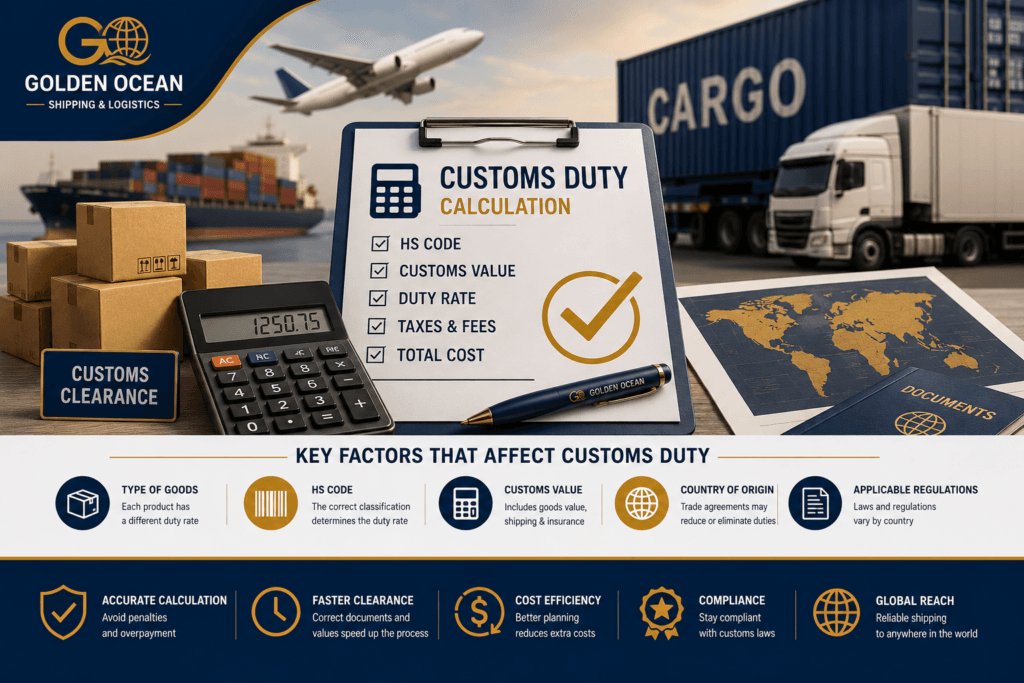
Factors That Affect Customs Duty Calculation
Several variables determine how much duty you will pay when importing goods.
1. HS Code (Harmonized System Code)
Every internationally traded product is assigned an HS Code, which determines the applicable customs duty rate.
Incorrect classification can lead to:
- Higher duties
- Customs delays
- Financial penalties
- Shipment inspections
Using the correct HS Code is one of the most important steps in customs compliance.
2. Country of Origin
The country where the product was manufactured may affect the duty rate.
Many countries have Free Trade Agreements (FTAs) that reduce or eliminate customs duties for qualifying products.
For example:
- GCC agreements
- European Union agreements
- ASEAN agreements
- USMCA (North America)
Always verify whether your shipment qualifies for preferential tariff treatment.
3. Customs Value
Customs duties are usually calculated based on the customs value of the shipment.
In many countries, customs authorities use the CIF value, which includes:
- Product value
- Freight cost
- Insurance cost
Formula:
Customs Value = Product Cost + Freight + Insurance
This amount becomes the basis for calculating customs duties.
CIF vs. FOB: Which Value Is Used for Customs?
One of the most common questions importers ask is whether customs duties are calculated using the FOB (Free on Board) value or the CIF (Cost, Insurance, and Freight) value.
In many countries—including the UAE and numerous other customs jurisdictions—the CIF value is used as the basis for calculating customs duties. However, customs valuation rules vary by country, and some jurisdictions may apply different methods depending on their regulations.
Here’s the difference:
| Value Type | Includes Product Cost | Includes Freight | Includes Insurance | Commonly Used for Customs? |
|---|---|---|---|---|
| FOB | ✅ | ❌ | ❌ | Sometimes |
| CIF | ✅ | ✅ | ✅ | Most Common |
If you’re unsure which method applies in your destination country, check with the local customs authority or consult your freight forwarder before shipping.
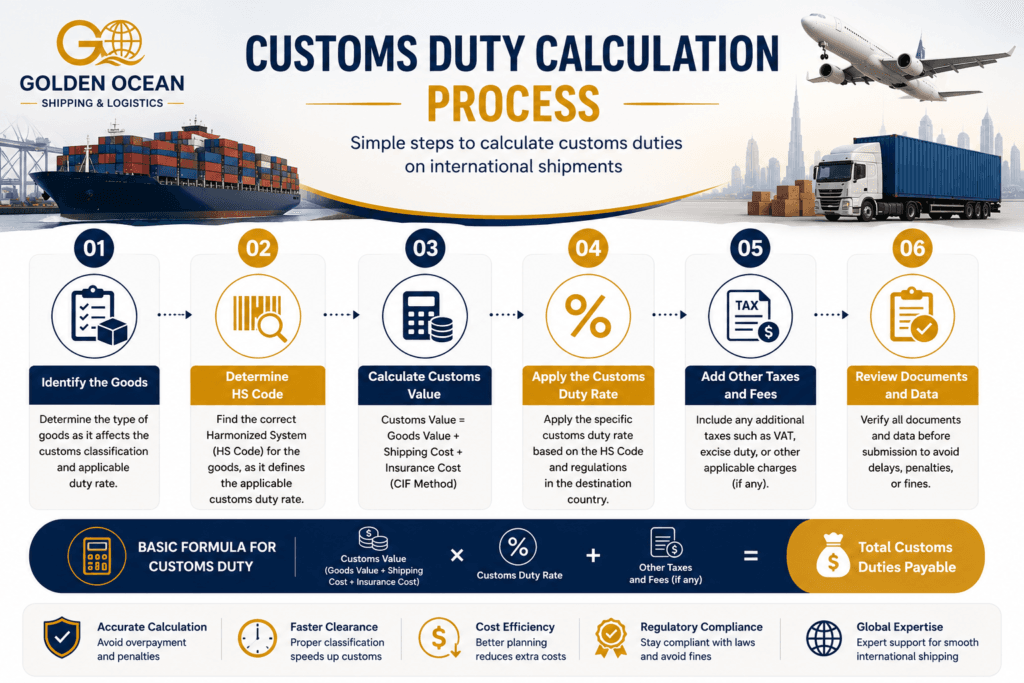
Step-by-Step: How to Calculate Customs Duties
Although customs procedures differ from one country to another, the calculation process generally follows the same sequence.
Step 1: Determine the Customs Value
Start by calculating the customs value of your shipment.
Formula
Customs Value = Product Value + Freight Cost + Insurance Cost
Example
- Product Value: USD 8,000
- Freight Cost: USD 700
- Insurance: USD 100
Customs Value = USD 8,800
Step 2: Identify the Correct HS Code
Every imported product has an HS Code that determines its duty rate.
Examples include:
- Electronics
- Furniture
- Clothing
- Automotive parts
- Machinery
- Medical equipment
Even products that appear similar may have different duty rates, making accurate classification essential.
The Harmonized System (HS) is maintained by the World Customs Organization (WCO), and using the correct HS Code is essential for determining the applicable customs duty rate. You can learn more about the system through the World Customs Organization (WCO) HS Classification Resources
Step 3: Find the Applicable Duty Rate
The duty rate depends on several factors, including:
- Product classification (HS Code)
- Country of origin
- Trade agreements
- Destination country’s tariff schedule
For example:
| Product | Example Duty Rate |
|---|---|
| Electronics | 5% |
| Furniture | 10% |
| Clothing | 12% |
| Industrial Machinery | 0–5% |
Note: These percentages are illustrative only. Always verify the current tariff rate with the customs authority in the destination country before estimating import costs.
Step 4: Calculate Import Duty
Use the following formula:
Import Duty = Customs Value × Duty Rate
Example
Customs Value:
USD 8,800
Duty Rate:
5%
Calculation:
8,800 × 5%
Import Duty = USD 440
Step 5: Calculate VAT (If Applicable)
Many countries charge VAT or GST on imported goods.
In many jurisdictions, VAT is calculated on the combined value of:
- Customs Value
- Import Duty
- Other applicable customs charges
Example
Customs Value:
USD 8,800
Import Duty:
USD 440
VAT Rate:
5%
VAT Calculation:
(8,800 + 440) × 5%
VAT = USD 462
Step 6: Add Additional Import Charges
Besides customs duties and VAT, importers may also pay:
- Customs clearance fees
- Port handling charges
- Terminal fees
- Documentation fees
- Inspection fees
- Storage charges (if applicable)
- Delivery charges
- Broker service fees
These costs vary by country, port, carrier, and customs broker, so they should be included when estimating the total landed cost.
Complete Customs Duty Calculation Example
Let’s put everything together.
Shipment Details
| Item | Amount |
|---|---|
| Product Value | USD 10,000 |
| Freight | USD 900 |
| Insurance | USD 100 |
| Customs Value | USD 11,000 |
| Duty Rate | 5% |
| Import Duty | USD 550 |
| VAT Rate | 5% |
| VAT | USD 577.50 |
| Estimated Total Before Local Charges | USD 12,127.50 |
Remember that local handling, brokerage, storage, or inspection fees may increase the final amount payable.
What Is the Total Landed Cost?
Many importers focus only on shipping costs and overlook the total cost of bringing goods to their final destination.
The landed cost generally includes:
- Product purchase price
- International shipping cost
- Insurance
- Customs duties
- Import taxes (such as VAT or GST)
- Customs clearance fees
- Port and terminal charges
- Local transportation
- Warehouse or storage fees (if any)
Calculating the landed cost before importing helps businesses set accurate selling prices and avoid unexpected expenses.
Common Mistakes When Calculating Customs Duties
Avoid these common errors:
- Using the wrong HS Code
- Declaring an incorrect customs value
- Forgetting to include freight or insurance when required
- Ignoring VAT or other import taxes
- Assuming all countries use the same duty rates
- Overlooking customs brokerage or port charges
- Failing to check eligibility for free trade agreements
Even small mistakes can lead to shipment delays, additional costs, or customs penalties.
How to Reduce Customs Duties Legally
While customs duties are mandatory in most countries, there are several legitimate ways to reduce your overall import costs without violating customs regulations.
1. Use the Correct HS Code
Product classification has a direct impact on the duty rate.
A single product may fall under different tariff headings depending on its specifications, materials, or intended use. Using the correct HS Code ensures that you pay the appropriate duty—no more and no less.
Always avoid intentionally misclassifying goods, as this can result in customs audits, penalties, shipment delays, or even seizure of the cargo.
2. Benefit from Free Trade Agreements (FTAs)
Many countries have signed Free Trade Agreements that reduce or eliminate customs duties on qualifying goods.
Depending on the destination and country of origin, your shipment may be eligible for preferential tariff treatment if you provide the required documentation, such as a Certificate of Origin.
Before shipping, verify whether a trade agreement applies to your products.
3. Declare the Correct Customs Value
Under-declaring the value of imported goods is illegal and can lead to:
- Financial penalties
- Customs reassessments
- Delayed clearance
- Additional inspections
- Possible legal action
Likewise, over-declaring the value may cause you to pay more duties than necessary.
Always declare the true transaction value supported by commercial invoices and shipping documents.
4. Prepare Accurate Shipping Documents
Incomplete or inconsistent documentation often results in customs delays and unexpected charges.
Typical documents include:
- Commercial Invoice
- Packing List
- Bill of Lading or Air Waybill
- Certificate of Origin (when applicable)
- Import permits (if required)
- Insurance certificate (if applicable)
Ensuring that all documents are accurate and consistent helps customs process your shipment more efficiently.
5. Work with an Experienced Customs Broker
A qualified customs broker can help you:
- Classify products correctly
- Verify applicable duty rates
- Prepare customs declarations
- Ensure compliance with local regulations
- Reduce clearance delays
- Avoid costly errors
For businesses importing regularly, professional customs support can save both time and money.
Can Customs Duties Be Calculated Before Shipping?
Yes. In most cases, you can estimate customs duties before your shipment leaves the origin country.
To calculate an estimate, you typically need:
- Product description
- HS Code
- Product value
- Freight cost
- Insurance cost
- Country of origin
- Destination country
With this information, you can estimate:
- Customs value
- Import duty
- VAT or GST
- Estimated landed cost
Keep in mind that the final assessment is always determined by the destination country’s customs authority.
Customs Duty Calculation Formula
The simplified calculation process looks like this:
Product Value
+ Freight
+ Insurance
= Customs Value

Customs Value × Duty Rate
= Import Duty

(Customs Value + Import Duty) × VAT Rate
= VAT

Total Import Cost =
Import Duty + VAT + Other Import Charges
This formula provides a practical framework for estimating import costs, although the exact calculation may vary depending on local customs regulations.
Frequently Asked Questions (FAQ)
How are customs duties calculated?
Customs duties are generally calculated based on the customs value of the shipment (often the CIF value) multiplied by the applicable duty rate for the product’s HS Code. Additional taxes, such as VAT or GST, may also apply depending on the destination country.
Are customs duties calculated before or after shipping?
Customs duties are assessed after the shipment reaches the destination country’s customs authority. However, importers can estimate these charges before shipping to budget accurately.
Does shipping cost affect customs duties?
Yes. In many countries, freight and insurance costs are included in the customs value used to calculate import duties.
Are customs duties the same in every country?
No. Each country has its own customs regulations, tariff schedules, tax rates, exemptions, and trade agreements. The same product may incur different duties depending on the destination.
Can I reduce customs duties legally?
Yes. You can reduce costs legally by using the correct HS Code, taking advantage of Free Trade Agreements, accurately declaring the customs value, and ensuring all shipping documents are complete and correct.
What happens if I declare the wrong customs value?
Incorrect declarations may result in additional duties, penalties, customs inspections, shipment delays, or legal consequences. Always provide accurate and verifiable information.
Conclusion
Understanding how to calculate customs duties is essential for anyone involved in international trade. By knowing how customs value is determined, applying the correct HS Code, estimating import duty and VAT, and accounting for additional charges, you can calculate your total landed cost with greater confidence.
Whether you’re importing a single shipment or managing regular international trade, careful planning and accurate customs calculations help prevent unexpected expenses, reduce delays, and support better financial decisions.
Need Help with International Shipping and Customs Clearance?
At Golden Ocean, we help businesses and individuals simplify international shipping through reliable freight forwarding, customs clearance, and logistics solutions.
Whether you’re importing commercial cargo, machinery, vehicles, or personal shipments, our experienced team can help you estimate shipping costs, prepare the required documentation, and ensure a smooth customs clearance process.
Contact us today for a customized shipping quotation and professional logistics support.