

Introduction
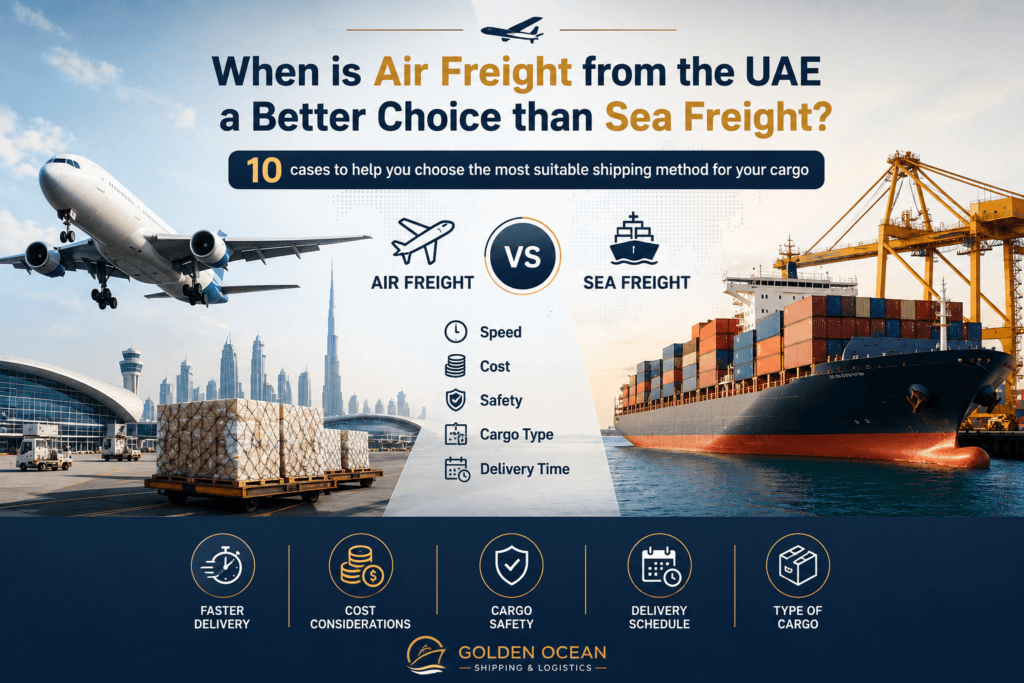
Air Freight vs Sea Freight is one of the most important decisions businesses face when shipping internationally from the UAE. Choosing the right shipping method affects delivery speed, transportation costs, cargo safety, and overall supply chain efficiency.
When comparing Air Freight vs Sea Freight, sea freight is generally the most cost-effective solution for large and heavy shipments, while air freight offers unmatched speed, security, and reliability for urgent, high-value, or time-sensitive cargo.
Understanding the differences between Air Freight vs Sea Freight helps importers and exporters avoid unnecessary expenses, reduce delivery delays, and select the most suitable shipping option for every shipment.
In this comprehensive guide, you’ll discover 10 situations where air freight is the better choice than sea freight, along with practical comparisons, expert tips, and real-world examples to help you make informed shipping decisions.
Table of Contents
In This Guide You’ll Learn
- The key differences between air freight and sea freight
- When air freight becomes the most cost-effective solution
- 10 real-world situations where air shipping is the better choice
- How shipment size, urgency, and cargo type affect your decision
- Practical tips to reduce shipping costs while meeting delivery deadlines
Air Freight vs Sea Freight: What’s the Main Difference?
Both shipping methods play an essential role in international logistics, but they serve different business needs.
The International Air Transport Association (IATA) develops global standards and best practices for the air cargo industry, helping ensure safe, secure, and efficient international air freight operations.
| Feature | Air Freight | Sea Freight |
|---|---|---|
| Delivery Speed | Very Fast | Slow |
| Shipping Cost | Higher | Lower |
| Best For | Urgent shipments | Large-volume cargo |
| Cargo Capacity | Limited | Very Large |
| Security | Very High | High |
| Global Coverage | Excellent | Excellent |
In many cases, paying more for faster transportation actually saves money by preventing production delays, stock shortages, or lost sales.
When Is Air Freight the Better Choice Than Sea Freight?
1. When Delivery Time Is Critical
The biggest advantage of air freight is speed.
If your shipment must arrive within days instead of weeks, air freight is usually the only practical solution.
Examples include:
- Emergency spare parts
- Medical supplies
- Last-minute customer orders
- Production materials
Businesses that rely on just-in-time inventory often prefer air freight to avoid costly downtime.
2. Shipping High-Value Goods
Expensive products benefit from faster transportation and reduced handling.
Examples include:
- Electronics
- Luxury products
- Jewelry
- Smartphones
- Computer equipment
Shorter transit times reduce exposure to theft, damage, and prolonged storage.
3. Transporting Perishable Products
Fresh products have a limited shelf life.
Air freight helps preserve product quality by minimizing transit time.
Suitable cargo includes:
- Fresh flowers
- Seafood
- Pharmaceuticals
- Vaccines
- Certain food products
4. Small Shipments with High Urgency
Not every shipment fills an entire container.
If you’re sending a few cartons or lightweight cargo that must arrive quickly, air freight often delivers better overall value despite the higher transportation cost.
Many SMEs in the UAE use air freight for urgent small shipments.
5. Meeting Customer Delivery Deadlines
Late deliveries can damage customer relationships.
Air freight helps businesses:
- Meet contractual deadlines
- Reduce customer complaints
- Improve customer satisfaction
- Protect brand reputation
This is especially important for e-commerce businesses serving international customers.
6. Preventing Production Line Interruptions
Manufacturing companies often depend on imported components.
If one essential part is missing, the entire production process may stop.
Shipping that critical component by air can save far more money than the additional freight cost.
7. Shipping Seasonal Products
Timing is everything for seasonal sales.
Examples include:
- Ramadan products
- Christmas merchandise
- Fashion collections
- Promotional campaigns
Receiving products after the selling season can result in major financial losses.
8. Delivering Samples Before Mass Production
Manufacturers frequently send product samples for customer approval.
Air freight allows:
- Faster testing
- Faster approval
- Earlier production
- Quicker market launch
This significantly shortens the overall project timeline.
9. Shipping Sensitive or Fragile Cargo
Certain products require minimal handling and shorter transportation periods.
Examples include:
- Laboratory equipment
- Precision instruments
- Medical devices
- Specialized electronics
Reduced transit time often means a lower risk of damage.
10. When Inventory Costs Matter More Than Freight Costs
Many businesses focus only on shipping rates.
However, inventory carrying costs can sometimes exceed transportation expenses.
Air freight helps businesses:
- Reduce warehouse costs
- Lower inventory levels
- Improve cash flow
- Respond faster to market demand
For fast-moving products, this can produce significant long-term savings.
Air Freight Isn’t Always the Best Choice
Despite its advantages, air freight isn’t suitable for every shipment.
Sea freight remains the better option when:
- Shipping heavy machinery
- Transporting large commercial quantities
- Budget is the primary concern
- Delivery deadlines are flexible
Choosing the right shipping method depends on balancing speed, cost, and cargo requirements.
How to Decide Between Air and Sea Freight
Ask yourself these questions:
- How urgent is the shipment?
- What is the shipment’s value?
- Is the cargo perishable?
- How large and heavy is the shipment?
- What is the available shipping budget?
- Will delivery delays create financial losses?
Answering these questions makes selecting the most suitable shipping method much easier.
Conclusion
There is no universal shipping solution that fits every business.
While sea freight remains the most economical option for bulk cargo, air freight from the UAE becomes the superior choice whenever speed, reliability, and business continuity are more valuable than transportation cost.
Understanding these 10 situations allows companies to make smarter logistics decisions, improve customer satisfaction, and optimize overall supply chain performance.
Need Professional Air Freight Services from the UAE?
At Golden Ocean, we provide reliable international air freight solutions tailored to your cargo, budget, and delivery deadlines.
Our logistics specialists help you choose the most efficient shipping method while ensuring safe handling, customs clearance, and on-time delivery worldwide.
Contact us today for a customized shipping quotation and expert logistics advice.
Read Also
- International Shipping Cost from the UAE: Complete Pricing Guide
- Required Shipping Documents for International Cargo
- Customs Clearance in the UAE: Step-by-Step Guide
- Volumetric Weight Explained: How It Affects Air Freight Costs
ممتاز، نكمل الآن الجزء الثاني بإضافة محتوى احترافي يزيد من قوة المقال وسيوه، ويجعله أكثر شمولًا من معظم المقالات المنافسة.
Air Freight vs Sea Freight: Transit Time Comparison from the UAE
Delivery time is often the deciding factor when choosing between air freight and sea freight. While exact transit times vary depending on the destination, customs procedures, and carrier schedules, the table below provides a general comparison.
| Destination | Air Freight | Sea Freight |
|---|---|---|
| GCC Countries | 1–3 Days | 5–12 Days |
| Middle East | 2–5 Days | 10–20 Days |
| Europe | 2–6 Days | 20–35 Days |
| North America | 3–7 Days | 30–45 Days |
| Asia | 2–5 Days | 15–30 Days |
| Africa | 3–7 Days | 20–40 Days |
Although air freight is considerably faster, businesses should also consider the overall shipping cost and cargo characteristics before making a decision.
Cost Comparison: Is Air Freight Worth the Extra Money?
Many companies focus solely on the shipping rate, but transportation cost is only one part of the total logistics expense.
A delayed shipment may lead to:
- Production downtime
- Missed sales opportunities
- Contract penalties
- Customer dissatisfaction
- Emergency replacement orders
- Increased warehousing expenses
In these situations, paying more for air freight can actually reduce overall business costs.
Types of Cargo Best Suited for Air Freight
Air freight is recommended for cargo that requires speed, security, or special handling.
Common examples include:
Electronics
- Smartphones
- Laptops
- Computer components
- Communication equipment
Medical Supplies
- Medicines
- Vaccines
- Medical devices
- Laboratory samples
Fashion and Retail
- Seasonal clothing
- Luxury brands
- Promotional products
Automotive Parts
- Emergency spare parts
- High-value vehicle components
E-commerce Orders
Online retailers often use air freight to satisfy customer expectations for fast international delivery.
Cargo Better Suited for Sea Freight
Sea freight remains the preferred option for shipments such as:
- Heavy machinery
- Construction materials
- Industrial equipment
- Furniture
- Bulk raw materials
- Large commercial orders
- Full Container Load (FCL) shipments
These goods are less sensitive to transit time and benefit from the lower transportation cost offered by ocean shipping.
Common Mistakes When Choosing Between Air and Sea Freight
Many businesses make logistics decisions based only on freight rates.
Avoid these common mistakes:
Choosing the Cheapest Option Without Considering Delivery Time
A lower shipping rate may lead to significant financial losses if delayed delivery affects business operations.
Ignoring Inventory Costs
Keeping large amounts of inventory in storage increases operational expenses.
Underestimating Customs Clearance Time
Shipping speed alone does not determine delivery time. Customs processing also plays a major role.
Selecting Air Freight for Heavy Cargo
Very heavy shipments often become prohibitively expensive by air.
Not Consulting Logistics Experts
Professional freight forwarders can recommend the most cost-effective solution based on shipment characteristics.
How Golden Ocean Helps You Choose the Right Shipping Method
Every shipment is unique.
At Golden Ocean, we evaluate several factors before recommending the most suitable transportation method, including:
- Shipment size
- Weight
- Cargo value
- Delivery deadline
- Destination country
- Customs requirements
- Budget
- Handling requirements
Our logistics specialists work closely with customers to balance speed, reliability, and cost efficiency.
Why Businesses in the UAE Trust Golden Ocean
Choosing a logistics partner is just as important as choosing the shipping method.
Golden Ocean offers:
- International air freight services
- Global sea freight solutions
- Customs clearance support
- Door-to-door shipping
- Commercial cargo handling
- Competitive freight rates
- Worldwide shipping network
- Professional logistics consultation
Whether you’re shipping a single urgent package or managing regular international cargo, our experienced team ensures a smooth shipping process from pickup to final delivery.
Final Thoughts
Both air freight and sea freight have clear advantages, and the best option depends on your business priorities.
If speed, reliability, and minimizing business disruption are your top concerns, air freight is often the ideal solution. On the other hand, if reducing transportation costs is more important and delivery deadlines are flexible, sea freight remains the smarter choice.
Before making a decision, evaluate your shipment’s urgency, value, size, destination, and overall logistics costs—not just the freight price.
With the right shipping strategy and the support of an experienced logistics provider like Golden Ocean, you can optimize your supply chain, improve customer satisfaction, and keep your business moving efficiently.
Pro Tips for Choosing Between Air Freight and Sea Freight
Selecting the right shipping method involves more than comparing freight rates. Experienced exporters and importers evaluate the total impact on their supply chain before making a decision.
Here are some practical tips to help you make the right choice:
Plan Your Shipments in Advance
Whenever possible, forecast your shipping needs early. Advanced planning allows you to take advantage of the lower costs of sea freight instead of paying premium rates for urgent air shipments.
Consider the Total Logistics Cost
Look beyond the transportation fee. Include inventory holding costs, warehousing expenses, potential production delays, and customer satisfaction when comparing shipping options.
Match the Shipping Method to the Cargo
Not every shipment requires the fastest transport. Heavy industrial equipment is usually better suited for sea freight, while high-value electronics and urgent spare parts often justify the higher cost of air freight.
Work with an Experienced Freight Forwarder
An experienced logistics partner can help you evaluate transit times, customs requirements, cargo restrictions, and transportation costs to recommend the most efficient solution for each shipment.
Balance Speed and Budget
Many successful businesses use a hybrid shipping strategy—shipping urgent items by air while transporting the remaining cargo by sea to optimize both delivery time and costs.
Case Study: How Choosing Air Freight Helped Avoid Costly Delays
A UAE-based electronics distributor received an urgent order from a retailer in Europe. The shipment consisted of high-value computer components required for a product launch scheduled within one week.
Sea freight would have reduced transportation costs significantly, but the estimated transit time exceeded the customer’s deadline by several weeks.
After evaluating the situation, the company chose air freight instead.
The Results
- The shipment arrived before the product launch.
- The customer avoided stock shortages.
- The distributor fulfilled the contract on time.
- The retailer placed additional orders due to the successful delivery.
- The extra freight cost represented only a small percentage of the overall order value.
This example demonstrates that the cheapest shipping option is not always the most profitable one. In time-sensitive situations, faster delivery can generate greater long-term value than immediate transportation savings.